I do not own it.
| ELECTRONEGATIVITY
This page explains what electronegativity is, and how and why it varies around the Periodic Table. It looks at the way that electronegativity differences affect bond type and explains what is meant by polar bonds and polar molecules. If you are interested in electronegativity in an organic chemistry context, you will find a link at the bottom of this page. What is electronegativityDefinition Electronegativity is a measure of the tendency of an atom to attract a bonding pair of electrons. The Pauling scale is the most commonly used. Fluorine (the most electronegative element) is assigned a value of 4.0, and values range down to caesium and francium which are the least electronegative at 0.7. What happens if two atoms of equal electronegativity bond together? Consider a bond between two atoms, A and B. Each atom may be forming other bonds as well as the one shown - but these are irrelevant to the argument.  | |
Note: It's important to realise that this is an average picture. The electrons are actually in a molecular orbital, and are moving around all the time within that orbital. | |
| This sort of bond could be thought of as being a "pure" covalent bond - where the electrons are shared evenly between the two atoms. What happens if B is slightly more electronegative than A? B will attract the electron pair rather more than A does. 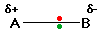  " (read as "delta") means "slightly" - so + means "slightly positive". " (read as "delta") means "slightly" - so + means "slightly positive".Defining polar bonds This is described as a polar bond. A polar bond is a covalent bond in which there is a separation of charge between one end and the other - in other words in which one end is slightly positive and the other slightly negative. Examples include most covalent bonds. The hydrogen-chlorine bond in HCl or the hydrogen-oxygen bonds in water are typical. What happens if B is a lot more electronegative than A? In this case, the electron pair is dragged right over to B's end of the bond. To all intents and purposes, A has lost control of its electron, and B has complete control over both electrons. Ions have been formed.  The implication of all this is that there is no clear-cut division between covalent and ionic bonds. In a pure covalent bond, the electrons are held on average exactly half way between the atoms. In a polar bond, the electrons have been dragged slightly towards one end. How far does this dragging have to go before the bond counts as ionic? There is no real answer to that. You normally think of sodium chloride as being a typically ionic solid, but even here the sodium hasn't completely lost control of its electron. Because of the properties of sodium chloride, however, we tend to count it as if it were purely ionic. | |
Note: Don't worry too much about the exact cut-off point between polar covalent bonds and ionic bonds. At A'level, examples will tend to avoid the grey areas - they will be obviously covalent or obviously ionic. You will, however, be expected to realise that those grey areas exist. | |
| Lithium iodide, on the other hand, would be described as being "ionic with some covalent character". In this case, the pair of electrons hasn't moved entirely over to the iodine end of the bond. Lithium iodide, for example, dissolves in organic solvents like ethanol - not something which ionic substances normally do. Summary
In a simple molecule like HCl, if the bond is polar, so also is the whole molecule. What about more complicated molecules? In CCl4, each bond is polar. 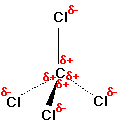 | |
Note: Ordinary lines represent bonds in the plane of the screen or paper. Dotted lines represent bonds going away from you into the screen or paper. Wedged lines represent bonds coming out of the screen or paper towards you. | |
| The molecule as a whole, however, isn't polar - in the sense that it doesn't have an end (or a side) which is slightly negative and one which is slightly positive. The whole of the outside of the molecule is somewhat negative, but there is no overall separation of charge from top to bottom, or from left to right. By contrast, CHCl3 is polar. 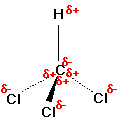 A polar molecule will need to be "lop-sided" in some way. Patterns of electronegativity in the Periodic TableThe most electronegative element is fluorine. If you remember that fact, everything becomes easy, because electronegativity must always increase towards fluorine in the Periodic Table. | |
Note: This simplification ignores the noble gases. Historically this is because they were believed not to form bonds - and if they don't form bonds, they can't have an electronegativity value. Even now that we know that some of them do form bonds, data sources still don't quote electronegativity values for them. | |
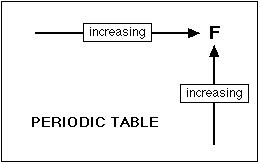 As you go across a period the electronegativity increases. The chart shows electronegativities from sodium to chlorine - you have to ignore argon. It doesn't have an electronegativity, because it doesn't form bonds. 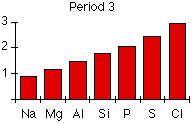 As you go down a group, electronegativity decreases. (If it increases up to fluorine, it must decrease as you go down.) The chart shows the patterns of electronegativity in Groups 1 and 7. 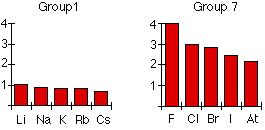 The attraction that a bonding pair of electrons feels for a particular nucleus depends on:
| |
Note: If you aren't happy about the concept of screening orshielding, it would pay you to read the page on ionisation energies before you go on. The factors influencing ionisation energies are just the same as those influencing electronegativities.Use the BACK button on your browser to return to this page. | |
| Why does electronegativity increase across a period? Consider sodium at the beginning of period 3 and chlorine at the end (ignoring the noble gas, argon). Think of sodium chloride as if it were covalently bonded. 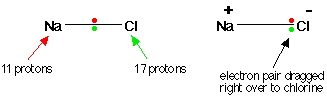 Electronegativity increases across a period because the number of charges on the nucleus increases. That attracts the bonding pair of electrons more strongly. Why does electronegativity fall as you go down a group? Think of hydrogen fluoride and hydrogen chloride. 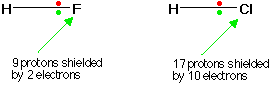 In each case there is a net pull from the centre of the fluorine or chlorine of +7. But fluorine has the bonding pair in the 2-level rather than the 3-level as it is in chlorine. If it is closer to the nucleus, the attraction is greater. As you go down a group, electronegativity decreases because the bonding pair of electrons is increasingly distant from the attraction of the nucleus. | |
| The polarising ability of positive ionsWhat do we mean by "polarising ability"? In the discussion so far, we've looked at the formation of polar bonds from the point of view of the distortions which occur in a covalent bond if one atom is more electronegative than the other. But you can also look at the formation of polar covalent bonds by imagining that you start from ions. Solid aluminium chloride is covalent. Imagine instead that it was ionic. It would contain Al3+ and Cl- ions. The aluminium ion is very small and is packed with three positive charges - the "charge density" is therefore very high. That will have a considerable effect on any nearby electrons. 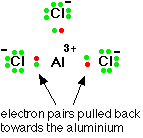 In the case of aluminium chloride, the electron pairs are dragged back towards the aluminium to such an extent that the bonds become covalent. But because the chlorine is more electronegative than aluminium, the electron pairs won't be pulled half way between the two atoms, and so the bond formed will be polar. Factors affecting polarising ability Positive ions can have the effect of polarising (electrically distorting) nearby negative ions. The polarising ability depends on the charge density in the positive ion. Polarising ability increases as the positive ion gets smaller and the number of charges gets larger. As a negative ion gets bigger, it becomes easier to polarise. For example, in an iodide ion, I-, the outer electrons are in the 5-level - relatively distant from the nucleus. A positive ion would be more effective in attracting a pair of electrons from an iodide ion than the corresponding electrons in, say, a fluoride ion where they are much closer to the nucleus. Aluminium iodide is covalent because the electron pair is easily dragged away from the iodide ion. On the other hand, aluminium fluoride is ionic because the aluminium ion can't polarise the small fluoride ion sufficiently to form a covalent bond. | |

No comments:
Post a Comment